How to Recognize Donors Without Making Every Thank-You Feel the Same
TLDR
The strongest donor recognition ideas are not necessarily expensive or public. Build a repeatable system around four elements: a prompt acknowledgment, the donor’s recognition preferences, specific evidence of impact, and meaningful milestones. Vary the format—personal notes, calls, updates, event moments, small physical touches, or public listings—but keep the message connected to what the supporter made possible.
Start with three recognition moments your team can deliver reliably, such as the first gift, a giving anniversary, and the close of a campaign. Assign an owner and deadline to each one, record completion in your donor database, and ask permission before publishing a donor’s name, gift, image, or story.
Recognition should be a system, not a shelf of gifts
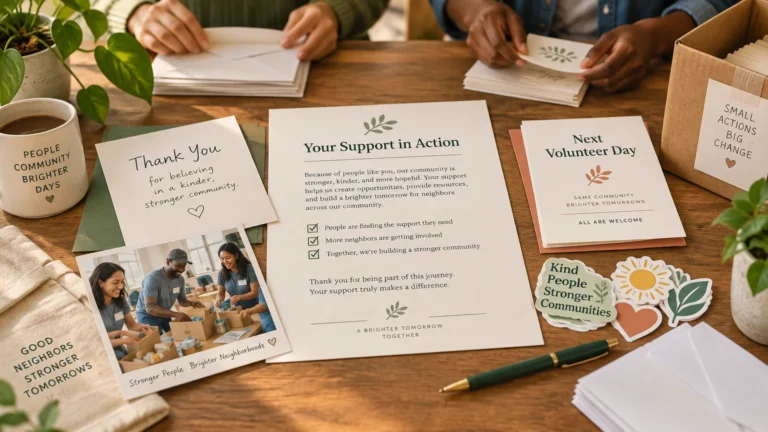
It is easy to treat recognition as a search for objects: plaques, certificates, tote bags, stickers, or gala favors. Those items can be useful, but they cannot carry the entire relationship. A generic gift mailed six months late will usually feel less thoughtful than a timely note explaining what happened because the donor participated.
A practical recognition system has three related jobs. Acknowledgment confirms and documents the contribution. Recognition honors the person or organization, sometimes publicly and sometimes privately. Stewardship continues the relationship by showing that the gift was handled responsibly and connected to real work. The Association of Fundraising Professionals includes acknowledgment, recognition, donor intent, and effective use of funds within ethical stewardship.
| Practice | Primary purpose | Useful formats | Important question |
|---|---|---|---|
| Acknowledgment | Confirm and document the contribution | Receipt, email confirmation, written letter | Did we provide the information the donor may need? |
| Recognition | Honor the supporter’s participation | Personal note, call, listing, event mention, milestone card | How does this donor want to be recognized? |
| Stewardship | Show how support connects to the mission | Impact update, project report, beneficiary-approved story, invitation | What changed, what did we learn, and what happens next? |
One communication can perform more than one job, but keeping these purposes distinct prevents a tax acknowledgment from becoming your only thank-you. It also helps your team notice when a donor has received plenty of receipts and appeals but little evidence that the contribution mattered.
Choose donor recognition ideas by moment, not only gift amount
Gift level can affect the amount of staff attention available, but it should not be the only trigger. A modest first gift, the start of a recurring commitment, an in-kind donation, or a volunteer-led fundraiser can each represent an important relationship moment.
Send a fast, specific personal thank-you
Create a short acknowledgment immediately after the gift, then add a human touch appropriate to your capacity. A staff member might write a sentence on a letter, a board member might make a two-minute call, or a program leader might record a brief campaign-wide video. Specificity matters more than elaborate language: name the program, event, need, or community effort the person chose to support.
Give callers and note writers a small set of facts rather than a rigid script. They need the donor’s preferred name, gift or campaign context, recognition preference, and one current program detail. They should not speculate about tax treatment, disclose private information, or turn the thank-you into another request.
Report progress without making another appeal
An impact update gives recognition substance. Explain what the campaign funded, what has happened so far, what remains unfinished, and what the organization learned. A small organization does not need a glossy annual report for every project. A short email with one result, one story used with permission, and one next step can be more useful.
If updates keep drifting into fundraising language, use a simple rule: let the subject line, opening, and main call to action serve the update. A future donation option can remain secondary. See how to make a donor update worth reading for a practical structure.
Mark relationship milestones
Milestones create natural variation without requiring a different system for every donor. Recognize a first gift, six or twelve months of recurring support, a giving anniversary, the completion of a pledge, or a campaign goal. A message such as “You have helped keep this weekly program running for a year” is more meaningful than an unexplained “gold supporter” label.
Recurring donors can receive a yearly summary of what their combined contributions supported. Peer-to-peer fundraisers can be thanked for organizing and communicating, not merely for the final total. Sponsors may need recognition tied to the written sponsorship agreement, while volunteers who also donate should be asked whether they prefer recognition for time, money, or both.
Use events to deepen connection
Recognition at an event can include a welcome from a program leader, a mission-focused briefing, reserved time to meet volunteers, or an invitation to see a project in action. Keep the experience connected to the organization’s work rather than creating an escalating menu of status perks.
For a gala, benefit, or community reception, coordinated printed invitations for a donor event can make the occasion feel intentional. The invitation should state the purpose, date, location, response instructions, accessibility information, and any important details about what the payment includes. This guide to community event invitations that make the purpose clear offers a useful planning framework.
Add small physical touches selectively
A mission-related bookmark, student artwork reproduction, campaign postcard, or supporter sticker can make a mailed thank-you memorable. Choose something inexpensive to store and mail, and make sure it makes sense for the audience. A family literacy group might send a bookmark; an animal rescue might use a campaign sticker; a neighborhood garden might send a small photo card showing the completed planting.
Do not assume a physical item is automatically insignificant for tax purposes. If you want to include stickers, review this guide to using custom stickers in donor thank-you mail, then assess the item’s cost, fulfillment work, mailing impact, and tax-documentation implications before committing to a large order.
Ask before recognizing donors publicly
Public recognition is optional, not the default. The Donor Bill of Rights says donors should receive appropriate acknowledgment and recognition while information about their donations is handled with respect and confidentiality to the extent provided by law. A name on a website, event screen, annual report, social post, or recognition wall should therefore follow a clear permission process.
Add a small group of preference fields to the donation form or donor record. Capture the preferred name, whether the donor approves public listing, whether the gift should remain anonymous, and relevant communication preferences. For organizational gifts, confirm the exact business or foundation name and ask whether a logo may be used.
Reconfirm permission before publishing a story, quotation, photograph, gift amount, or sensitive program connection. A donor who approves a name in an annual report has not necessarily approved a social-media profile. Make it easy to change a preference, and ensure that exported event lists and volunteer call sheets include only the information needed for that task.
Build a recognition matrix your team can manage
A simple matrix turns good intentions into assigned work. Adjust the timing to fit your staffing, payment system, mail schedule, and donor expectations rather than promising a standard your team cannot maintain.
| Donor moment | Recognition action | Owner | Target timing |
|---|---|---|---|
| First gift | Confirmation plus a personal sentence or brief call | Gift processor and assigned staff member | Confirmation promptly; personal follow-up within the team’s service standard |
| Recurring gift begins | Welcome message explaining future updates and preference options | Development coordinator | After enrollment is confirmed |
| Giving anniversary | One-year impact summary or milestone note | Donor relations lead | Near the anniversary |
| Sponsor confirmed | Written confirmation of agreed recognition and event details | Event lead | After the agreement and payment are recorded |
| Campaign closes | Results update, thanks, and explanation of what happens next | Campaign owner | After reliable results are available |
| Major or restricted gift | Tailored acknowledgment and agreed reporting schedule | Executive or development lead | According to the gift agreement and internal policy |
For each action, store the date completed, channel, staff owner, preference status, and any promised follow-up. Avoid recording subjective labels such as “difficult donor.” Useful notes describe decisions and obligations: “prefers postal mail,” “do not publish name,” or “send project update in September.”
Keep acknowledgment and donor benefits accurate
Recognition is relational, but some communications also carry tax-documentation responsibilities. The IRS states that a donor needs a contemporaneous written acknowledgment to substantiate a federal charitable deduction for a single contribution of $250 or more. For an applicable gift, the acknowledgment includes the organization’s name, the cash amount or a description of noncash property, and a statement addressing whether the organization provided goods or services in exchange.
Payments connected to meals, tickets, merchandise, or special access need additional care. The IRS defines a quid pro quo contribution as a payment made partly as a contribution and partly for goods or services. For a quid pro quo contribution over $75, a charity generally must provide a written disclosure explaining the deductible amount and giving a good-faith estimate of the value of the goods or services.
Do not use the recognition letter to guess at value or deductibility. Establish an internal review process for events, merchandise, memberships, and benefit packages before promoting them. Keep the warm thank-you, but make the required documentation precise. State and organization-specific requirements may also apply, so obtain qualified guidance when the arrangement is complicated.
A 90-day donor recognition reset
- Audit the last three months of gifts. Check how long acknowledgments took, whether personal follow-ups happened, and which donors received no mission update.
- Add recognition preferences. Record preferred names, anonymity, public-listing permission, communication choices, and any promised reports.
- Choose three reliable moments. Start with a first-gift thank-you, a recurring-donor milestone, and a campaign-close update rather than launching ten new tactics.
- Create short templates. Prepare an acknowledgment, handwritten-note prompt, call guide, campaign update, and public-listing permission request. Leave room for one specific sentence.
- Assign owners and backups. Decide who processes the gift, who makes calls, who approves public recognition, and who checks incomplete tasks each week.
- Run one focused recognition effort. Ask board members or volunteers to complete a manageable batch of calls or notes using limited, appropriate donor information.
- Review after 90 days. Measure completion, delays, returned mail, preference changes, and outstanding promises. Improve the process before adding another recognition tier.
A small team might begin with 40 new donors. If each personal note takes four minutes to review, write, and log, the batch requires about 160 minutes, or two hours and 40 minutes, excluding printing and mailing. Divide it among four trained people and each person handles about 40 minutes of writing. This simple capacity check is more useful than adopting an elaborate program nobody can sustain.
Make the next thank-you recognizably human
Choose three recognition moments your organization can complete consistently this quarter. Assign each one an owner, deadline, backup, and database field. Then send one impact update that closes the loop on a recent campaign.
Variety does not require constant novelty. It comes from responding to the donor’s actual moment: welcoming a first gift, honoring a preference, marking a milestone, sharing credible progress, or inviting someone closer to the work. When those moments are timely, specific, and respectful, recognition feels personal without becoming unmanageable.