Are Vinyl Stickers Waterproof? What Waterproof Really Means
*TLDR
Laminated vinyl stickers can handle rain, splashes, condensation, handwashing, and normal use on water bottles. Many can also survive dishwasher cycles, though heat, detergent, water pressure, surface shape, and application quality affect how long they last.
But “waterproof” does not mean every sticker can remain underwater forever. The vinyl, printing, laminate, adhesive, application surface, and length of exposure all affect performance.
A sticker can survive a thunderstorm and still fail in a dishwasher. It can look perfect after weeks on a water bottle but begin lifting after one afternoon underwater.
So, are vinyl stickers waterproof? In practical terms, high-quality laminated vinyl stickers are waterproof enough for most normal uses. They resist rain, spills, handwashing, condensation, and repeated exposure to moisture. But prolonged submersion, pool chemicals, saltwater, pressure washing, and hot dishwasher cycles create harsher conditions.
The confusion comes from treating a sticker as one material. A printed sticker is actually a layered system. Its performance depends on the vinyl, ink, laminate, adhesive, surface, and application.
Understanding those layers makes “waterproof” much easier to define.
What Does Waterproof Mean for a Sticker?
A waterproof sticker should resist water without the face material dissolving, swelling, tearing, or allowing the printed design to wash away.
Vinyl works well because it is a plastic film rather than an absorbent paper. Water can sit on the surface without soaking through it in the same way it would with an untreated paper sticker.
That does not make every part of the finished sticker equally resistant to water.
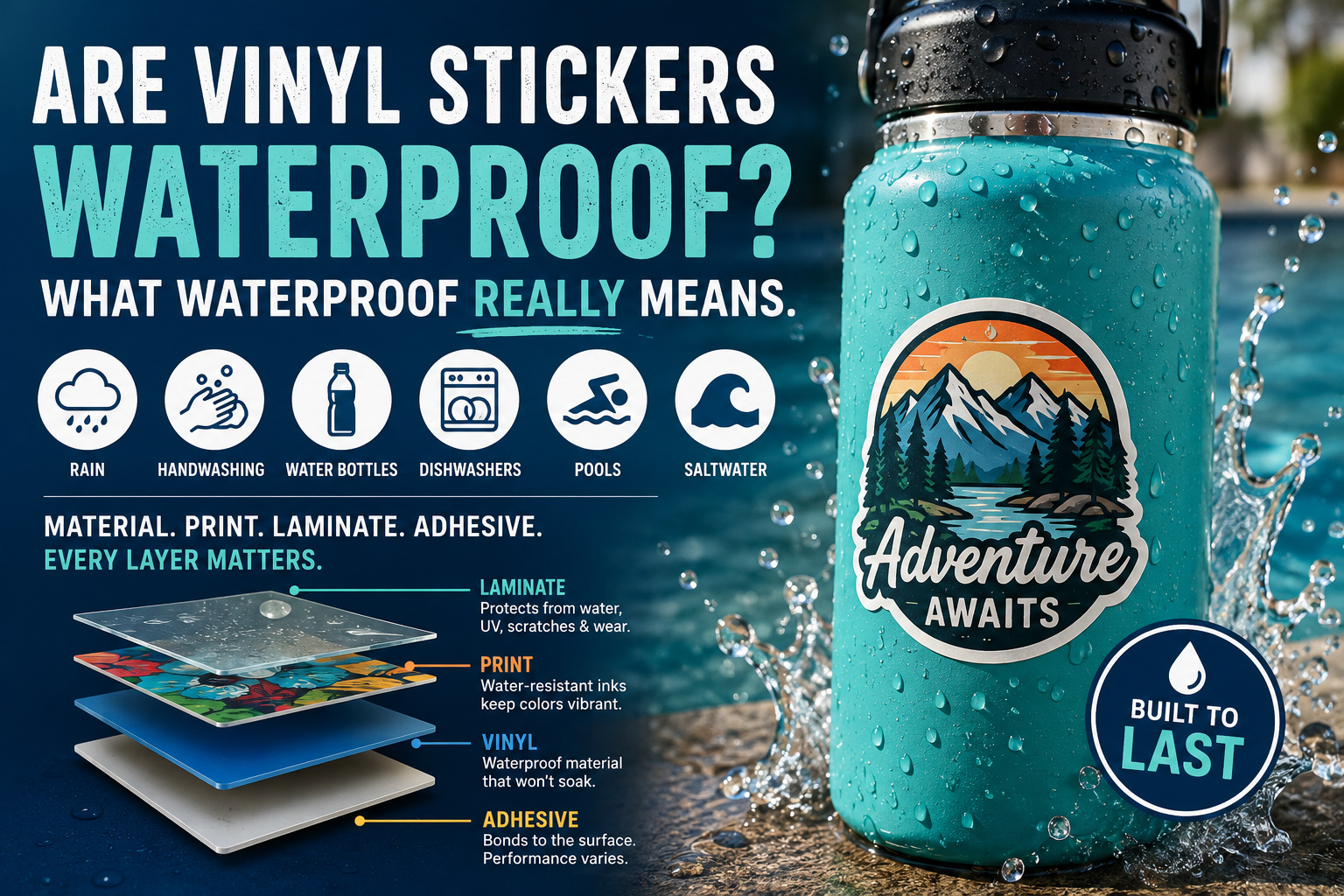
A typical laminated vinyl sticker includes four main layers:
- A clear protective laminate
- Printed ink
- A vinyl face film
- A pressure-sensitive adhesive
The laminate and vinyl may remain unaffected by water while the adhesive begins lifting from the object underneath. Or the adhesive may hold firmly while an unprotected print becomes scratched or faded.
That is why the better question is not simply, “Is vinyl waterproof?” It is, “Is the entire printed and applied sticker suited to this type of water exposure?”
Major graphic-film manufacturers make this distinction in their own technical documents. Some films are described as having excellent resistance to water while specifically excluding immersion. Specialized films may be separately tested for hours, days, or longer periods underwater.
Waterproof Material and Water-Resistant Printing Are Not the Same
The vinyl face material forms the body of the sticker. Because vinyl does not absorb water like ordinary paper, it is a strong choice for outdoor stickers, vehicle decals, water bottles, coolers, helmets, and equipment.
But the printed image is a separate part of the construction.
Some inks resist moisture well on their own. Others may scratch, fade, smear, or wear down more quickly when exposed to water, soap, friction, and sunlight. The printing method, ink chemistry, curing process, and surface coating all matter.
This creates an important distinction:
- Waterproof material means the sticker’s base film does not readily absorb or break down in water.
- Water-resistant printing means the ink can tolerate some contact with moisture without running, fading, or rubbing away.
- Laminated protection means a clear film covers the print and shields it from water, scratches, sunlight, and handling.
A sticker printed on vinyl but left unlaminated may still survive a splash. But it will usually have less protection from scratches, cleaning, rubbing, and repeated exposure.
CustomStickers prints its waterproof stickers on vinyl and adds a matte or gloss laminate that protects the ink from water and UV exposure. The company lists water bottles, coolers, cars, outdoor use, and dishwashers among the intended applications.
What Sticker Laminate Actually Does
Laminate is a thin, clear protective film applied over the printed surface.
It acts as the sticker’s first line of defense. Instead of water, fingers, cleaning cloths, and sunlight contacting the ink directly, they contact the laminate.
A good laminate helps protect against:
- Water and condensation
- Scratches and scuffs
- Color fading from sunlight
- Light chemical exposure
- Hand oils
- Repeated handling
- Mild cleaning
Laminate is especially important on water bottles and tumblers because those stickers face more than water. They are handled throughout the day, rubbed against bags, washed with soap, and exposed to changing temperatures.
But laminate does not seal the sticker inside a completely enclosed pouch. The cut edges remain exposed. If water reaches a lifted edge or finds a gap between the adhesive and surface, it may begin working underneath the sticker.
This is why proper application matters almost as much as laminate quality.
Adhesive Performance Is Often the Real Limiting Factor
When a waterproof sticker fails, the vinyl itself is rarely the first part to disappear. More often, an edge begins to lift.
Sticker adhesives are generally pressure-sensitive. They form a bond when the sticker is pressed firmly against a suitable surface. No water, heat, or separate curing agent is needed to activate them.
However, bond strength depends on several conditions:
- The surface must be clean and dry.
- The sticker must receive firm, even pressure.
- The adhesive needs enough contact with the surface.
- Smooth surfaces usually produce better contact than rough ones.
- Oils, dust, soap residue, wax, and condensation can interfere with adhesion.
- Some plastics are naturally harder to bond to.
- Sharp curves may place constant tension on the sticker edges.
Pressure-sensitive adhesive guidance generally recommends applying to a surface that is clean, dry, and free from grease, oil, lint, and other contamination.
For the strongest result, apply the sticker before the item gets wet. Press across the entire surface, paying particular attention to the edges. Then allow the bond to develop before washing or exposing it to heavy moisture.
A waiting period of 24 to 48 hours is a sensible rule for water bottles, tumblers, coolers, and similar items.
Are Vinyl Stickers Waterproof in Common Situations?
Standard laminated vinyl stickers can reasonably handle many everyday wet conditions. The table below shows where performance is usually reliable and where it may vary.
| Situation | Can Laminated Vinyl Stickers Handle It? | What to Expect |
|---|---|---|
| Light rain | Yes | A properly applied laminated vinyl sticker should handle normal rain without damage. |
| Heavy rain and outdoor weather | Yes | Good vinyl, laminate, and permanent adhesive are made for repeated weather exposure. Surface preparation still matters. |
| Condensation on a cold bottle | Yes | Condensation should not damage the vinyl or laminated print. Poorly sealed edges may eventually lift. |
| Spills and splashes | Yes | Wipe the sticker clean rather than leaving liquid around the edges for long periods. |
| Handwashing | Yes | Use mild soap and avoid scraping, soaking, or aggressively rubbing the edges. |
| Daily water bottle use | Yes | Laminated vinyl is well suited to bottles and tumblers, especially on smooth surfaces. |
| Dishwasher cycles | Usually, but performance varies | Heat, detergent, water jets, surface shape, and cycle length make dishwashers harsher than handwashing. |
| Poolside splashes | Yes | Occasional contact with chlorinated water should generally be manageable. Rinse and dry the item afterward. |
| Swimming or short pool submersion | Possibly | Short exposure may be fine, but chlorine, movement, abrasion, and edge exposure can shorten sticker life. |
| Saltwater splashes | Usually | Vinyl films can resist salt and water exposure, but the item should be rinsed with fresh water afterward. |
| Short freshwater submersion | Varies | Some stickers may remain unaffected, but standard outdoor durability does not always include immersion. |
| Prolonged freshwater submersion | Not normally recommended | Use a material and adhesive system specifically tested for continuous or extended immersion. |
| Prolonged saltwater submersion | Use a specialized product | Marine, industrial, or BS 5609-tested label systems are more appropriate than ordinary promotional stickers. |
| Pressure washing | Not recommended | High-pressure water can catch exposed edges and force water underneath the sticker. |
These are practical expectations rather than universal guarantees. Sticker construction, adhesive type, surface material, application, temperature, and maintenance can all change the result.
Rain and Outdoor Weather
Rain is one of the easiest situations for a laminated vinyl sticker to handle.
The water typically hits the face of the sticker and runs off. It does not remain under pressure against the adhesive for hours, and it usually has time to dry between exposures.
This is why outdoor vinyl films may be rated for years of exterior use while still excluding underwater immersion from their water-resistance claims. One 3M graphic film, for example, lists excellent resistance to water but makes clear that the rating does not include immersion.
Outdoor sticker life still depends on more than rain. Direct sun, heat, freezing temperatures, dirt, abrasion, and surface condition also affect durability.
For cars, trailers, signs, coolers, and equipment, apply the sticker to a smooth, clean surface. Avoid placing an ordinary sticker over rust, peeling paint, textured plastic, wax, or a heavily curved edge.
Handwashing and Water Bottles
Laminated vinyl stickers are a practical choice for reusable water bottles.
They regularly handle condensation, spills, wet hands, and gentle handwashing. The laminate protects the printed design, while the vinyl prevents water from soaking into the sticker face.
To extend sticker life:
- Apply the sticker to a clean, dry bottle.
- Avoid seams and sharp curves.
- Keep the sticker away from the bottle’s bottom edge, where it may scrape against tables.
- Press down the entire sticker firmly.
- Wait at least 24 hours before washing.
- Wash with mild soap and a soft sponge.
- Do not pick or scrub at the edges.
Handwashing is generally the safest option because it gives you control over heat, pressure, soap, and contact with the sticker.
Are Vinyl Stickers Dishwasher Safe?
Many laminated vinyl stickers can survive dishwasher cycles, particularly when they use a strong permanent adhesive and are applied correctly to a smooth bottle or tumbler.
CustomStickers identifies its laminated waterproof vinyl stickers as dishwasher safe.
Still, a dishwasher is a tougher environment than rain or handwashing. It combines:
- Sustained heat
- High-pressure spray
- Strong detergent
- Long exposure to moisture
- Repeated heating and cooling
- Friction from nearby items
The bottle itself also expands and contracts as its temperature changes. That movement can place stress on sticker edges.
A sticker that survives one dishwasher cycle may not look identical after 100 cycles. Results can also differ between a smooth stainless steel bottle, powder-coated tumbler, flexible plastic cup, and textured cooler.
For maximum life, place the item on the upper rack, use moderate wash settings, and avoid heated drying when practical. Handwashing remains the lower-risk choice.
Pools and Chlorinated Water
A splash at the pool is much different from leaving a sticker underwater all afternoon.
Laminated vinyl should handle poolside splashes and wet hands. Short periods of submersion may also be fine when the sticker has a strong bond to a smooth surface.
But a swimming pool introduces several extra factors:
- Continuous immersion
- Chlorinated water
- Movement through the water
- Rubbing against hands, gear, and pool surfaces
- Heat and direct sunlight
- Water pressure against exposed edges
For a sticker on a water bottle sitting beside the pool, ordinary laminated vinyl is a reasonable choice. For a sticker placed on equipment that remains underwater, use a product specifically designed and tested for submerged service.
Saltwater and Marine Use
Saltwater splashes do not automatically destroy a vinyl sticker. Some graphic films are specifically rated to resist water, mild chemicals, and salt.
But resistance to salt spray is not the same as long-term underwater performance. 3M technical data for several graphic films lists resistance to salt and water while excluding immersion.
Specialized materials do exist for more demanding marine conditions. One Avery Dennison film data sheet reports no effect after 48 hours of water immersion and includes a separate sea-water resistance test based on half-tide immersion. That rating belongs to that specific film system, not to every vinyl sticker.
For boats, kayaks, surf gear, and marine equipment, think about where the sticker will be placed.
Above the waterline with occasional spray is one thing. Constant immersion, barnacle growth, fuel exposure, cleaning chemicals, and abrasive contact are another.
After saltwater exposure, rinsing the surface with fresh water can help prevent salt and dirt from building up along the sticker edges.
Why Prolonged Submersion Is Different
Rain falls onto a sticker. Submersion surrounds it.
When a sticker remains underwater, water has more time to reach every edge and exploit any small gap between the adhesive and surface. Temperature changes, flexing, chemicals, and water pressure can make that process faster.
This does not mean every standard sticker will immediately fail underwater. Some may remain intact for days or longer. But unless the exact material, print, laminate, and adhesive combination has been tested for immersion, the result is difficult to predict.
For underwater equipment, buoys, marine containers, pool hardware, laboratory containers, and industrial applications, use labels with documented immersion and chemical-resistance ratings.
“Outdoor rated” is not automatically the same as “submersion rated.”
How to Make Waterproof Stickers Last Longer
The sticker’s construction matters, but application makes a large difference.
Start with a hard, smooth surface. Clean away dirt, grease, fingerprints, and soap residue. Allow the surface to dry fully before applying the sticker.
Then position the sticker and press from the center outward. Firm pressure helps the adhesive make full contact and pushes out trapped air.
Pay attention to the edges. Rounded corners and smooth die-cut shapes often handle wet use better than long, sharp points that can catch on hands, sponges, clothing, or equipment.
After application, give the sticker time to bond before exposing it to water.
And when cleaning, avoid attacking the edges. Most stickers do not fail because water passes directly through the center of the vinyl. They fail because an edge is lifted, scraped, or poorly bonded.
What Waterproof Really Means
So, are vinyl stickers waterproof? For rain, splashes, condensation, handwashing, water bottles, and most everyday outdoor uses, a quality laminated vinyl sticker can reasonably be called waterproof.
But the word needs context.
It does not always mean unlimited dishwasher cycles. It does not guarantee permanent adhesion to every plastic or textured surface. And it does not automatically make a standard promotional sticker suitable for months underwater.
The most reliable sticker combines a water-resistant vinyl film, durable printing, protective laminate, suitable adhesive, careful application, and realistic expectations about where it will be used.
That is what waterproof really means.